


Why is Selecting a Verified China Tipper Trailer Factory for Russian Market Logistics Critical to Overcoming Severe Sub-Zero Operational Risks?
July 8, 2026
Selecting a verified China tipper trailer factory for Russian market logistics is critical because a qualified manufacturer implements specialized low-temperature metallurgical engineering, installs heavy-duty reinforced axle assemblies, and secures official regulatory compliance certifications like the OTTC to withstand extreme Eurasian climate conditions. Fleet operators across Siberia and the Far East frequently face catastrophic structural chassis failures, hydraulic fluid freezing, and rapid pneumatic valve degradation when operating unreinforced standard commercial vehicles in sub-zero environments. By contracting with an experienced, technically proficient manufacturing partner, logistics firms eliminate these costly operational vulnerabilities, protect their initial transport capital investments, and maximize payload efficiencies during heavy-duty cross-border haulage campaigns.
For example, a prominent mining enterprise operating within the Amur Oblast previously experienced severe financial setbacks after purchasing standard-grade hauling equipment from an unverified regional trading broker. The steel cargo boxes suffered extensive structural cracking along the primary stress welds within three months of service due to low-temperature embrittlement during heavy iron ore dumping runs. After pivoting to cooperate directly with a certified China tipper trailer factory for Russian market deployment, the mining firm integrated custom-engineered transport assets tailored specifically to local road profiles. This strategic shift reduced vehicle downtime by forty-five percent and completely brought component structural lifespans into alignment with long-term commercial financial projections.
Managing heavy industrial transport across the Russian Federation requires precise mechanical intervention rather than generalized fleet adaptations. Corporate procurement managers cannot rely on standard specifications when vehicles must regularly haul heavy payloads over unpaved routes in temperatures dropping below minus forty degrees Celsius. A dedicated industrial manufacturer addresses these specific regional challenges directly on the assembly floor by utilizing specialized cold-resistant alloys, frost-proof electronic wiring harnesses, and advanced double-acting hydraulic cylinders. This upfront engineering optimization guarantees long-term chassis durability, preserves overall vehicle safety margins, and stabilizes corporate logistics budgets in highly volatile operational sectors.
What Metallurgical Innovations Prevent Structural Frame Embrittlement in Low-Temperature Eurasian Transport Corridors?
The primary engineering threat to heavy transport machinery operating in extreme cold zones is low-temperature steel embrittlement. Standard carbon steels experience a sharp drop in impact toughness when exposed to sub-zero temperatures, transforming a flexible structural chassis into a fragile, brittle frame that fractures easily under heavy shock loads. When a heavy-duty vehicle navigates rough terrain or dumps massive payloads of frozen earth, an unreinforced chassis is highly susceptible to sudden structural failures along the main longitudinal beams.
A premier engineering facility mitigates this structural risk by building the entire main frame assembly out of specialized high-strength low-alloy structural steel, such as Q355B or HG60. These advanced steel grades are formulated with precise micro-alloying elements like vanadium and titanium, which refine the internal grain matrix and maintain high structural ductility in extreme cold. The factory also uses specialized robotic welding processes to ensure deep weld penetration and minimize internal residual stresses, which prevents micro-cracks from forming under high stress.
Furthermore, structural reinforcement plates are strategically added to the highest stress areas, including the suspension mountings, the fifth wheel kingpin plate, and the rear tipping hinges. These integrated structural reinforcements evenly distribute heavy payload forces across the entire chassis frame rather than letting stresses build up at vulnerable points. This careful design planning ensures that the heavy vehicle can continuously haul maximum legal payloads without experiencing structural warping, beam buckling, or premature weld separations.
How Do Specialized Cold-Resistant Hydraulic Lifting Systems Maintain Operational Speed During Severe Arctic Rushes?
The hydraulic lifting system is the mechanical core of any commercial dumping vehicle, and its functional efficiency drops significantly when temperatures fall. Standard hydraulic mineral oils thicken quickly in extreme cold, creating high flow resistance that strains pump seals and slows down dumping cycle times. At the same time, standard rubber sealing rings become hard and brittle in low temperatures, which often leads to severe fluid leaks along the main lift piston stages.
To prevent these hydraulic failures, a specialized production facility uses heavy-duty, multi-stage telescopic lifting cylinders engineered with custom low-temperature polyurethane seals that stay flexible down to minus forty-five degrees Celsius. The entire fluid routing system is optimized with wider steel oil lines to reduce internal fluid friction and prevent system blockages during high-speed fluid movements.
- Low-Viscosity Specialized Hydraulic Oils: Utilizing advanced synthetic fluids that keep their optimal flow properties across wide temperature swings to prevent pump cavitation.
- Double-Acting Mechanical Control Valves: Installing precision pneumatic valves equipped with integrated heating elements to stop internal moisture from freezing the controls.
- Thickened High-Strength Cylinder Walls: Manufacturing internal lift tubes out of premium seamless steel to handle sudden internal fluid pressure spikes safely.
- Thermal Hose Insulation Wrappings: Enclosing flexible rubber oil lines in durable protective jackets to shield them from flying rocks and biting arctic winds.
Why is Completing the Official Russian OTTC Certification Protocol Non-Negotiable for Chinese Manufacturers?
The Approval of Vehicle Type, commonly known as the OTTC certificate, serves as the primary legal gateway for importing commercial transport machinery into the Eurasian Economic Union. This strict regulatory framework ensures that all foreign-built vehicles comply with Eurasian customs union safety regulations, braking standards, and environmental protection rules. Attempting to ship commercial heavy machinery across border entry points without a valid OTTC certificate results in immediate border impoundments and expensive legal fine structures.
A professional industrial manufacturing facility manages this complex legal registration process by working closely with accredited international testing bureaus to run full technical validation audits. These technical reviews include strict checking of dual-circuit pneumatic braking systems, anti-lock braking electronics, and side underrun protection barriers. Achieving this certification proves the factory can consistently build high-quality heavy vehicles that pass all legal customs checks and can be registered for commercial use across the continent.
Engineering Analysis of Regional Transport Design Adjustments
The table below provides a detailed technical comparison showing how special vehicle designs built for regional logistics compare to standard mass-market transport equipment.
Table 1: Technical Specifications for Specialized Regional Transport Equipment
| Engineering Component Profile | Standard Commercial Mass-Market Design | Certified Cold-Climate Regional Engineering |
| Chassis Steel Composition | Standard carbon Q345 structural steel | High-strength low-alloy Q355B or HG60 steel |
| Hydraulic Operating Range | Zero to minus fifteen degrees Celsius | Down to minus forty-five degrees Celsius |
| Suspension Component Setup | Light multi-leaf spring assemblies | Heavy-duty reinforced mechanical leaf suspension |
| Braking Safety Automation | Basic mechanical drum configurations | Advanced dual-circuit electronic ABS tracking |
| Axle Load Capacity Ratings | Twelve-ton standard commercial grade | Sixteen-ton heavy-duty reinforced mining axles |
What Dimensional and Shape Configurations Maximize Payload Efficiency for Frozen Aggregates?
Hauling frozen mining materials, sticky clay, or heavy bulk aggregates poses unique logistical challenges during long transport runs through sub-zero environments. Materials often freeze directly to the interior corners of standard square cargo boxes, creating a solid block of material that stays stuck inside the bed during the dumping cycle. This leftover cargo not only reduces total payload capacity on the next run but also dangerously shifts the vehicle center of gravity upward, increasing the risk of a rollover.
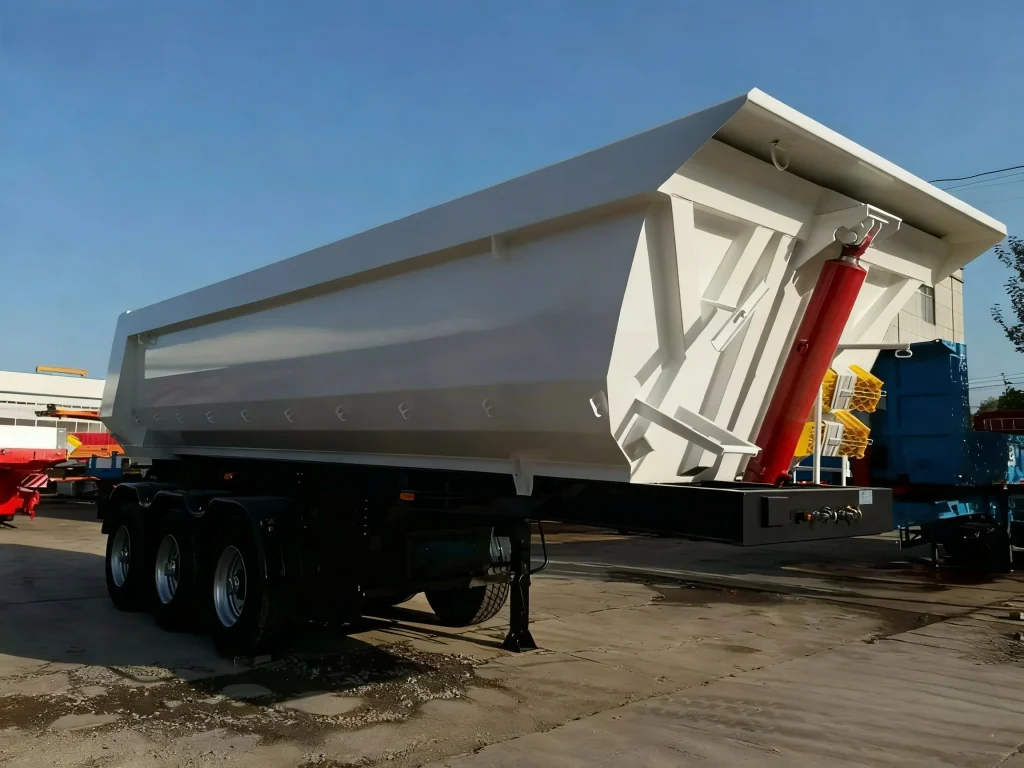
To solve this material-sticking issue, a knowledgeable China tipper trailer factory for Russian market supply routes will build custom U-shaped cargo bodies with curved floors. The smooth, rounded floor design eliminates sharp ninety-degree corners where wet materials can get trapped and freeze solid. The sloped interior walls let heavy bulk payloads slide out cleanly during dumping, which speeds up cycle times and reduces dangerous structural stress on the vehicle.
If you are ready to optimize your transport fleet and secure certified heavy equipment built for extreme climates, please contact our engineering team to receive a comprehensive technical proposal within twelve hours.
Additionally, top manufacturers can install specialized exhaust-gas heating channels inside the double-walled steel cargo floor. Hot exhaust gases from the truck engine flow through these internal floor channels, warming the steel plate and keeping materials from freezing to the bed. This advanced thermal engineering ensures complete material discharge on every dump, keeping your operations moving efficiently even during the coldest winter months.
How Do Heavy-Duty Axle Assemblies and Reinforced Suspensions Withstand Unpaved Mining Routes?
The harsh unpaved logging roads, remote mining tracks, and developing infrastructure routes across the region put immense stress on vehicle axles and suspension systems. Standard commercial suspension assemblies frequently suffer from broken leaf springs, cracked axle housings, and blown pneumatic shock absorbers when subjected to heavy loads on rough roads. Protecting your transport assets requires moving away from light highway-focused equipment toward heavy-duty, off-road mechanical systems.
A premier manufacturer addresses these tough road conditions by installing heavy-duty sixteen-ton axles coupled with heavy mechanical leaf spring suspensions. The axle beams are built with thicker walls to resist bending forces, while the wheel hubs feature upgraded taper roller bearings to handle heavy lateral loads.
- Reinforced Mechanical Leaf Springs: Utilizing wide, multi-leaf spring packs to dampen heavy impacts from deep potholes and rough terrain.
- Heavy-Duty Cast Steel Equalizers: Installing heavy-duty balance arms to distribute shifting payload weights evenly across all rear wheels.
- Enclosed Dust Protection Caps: Adding heavy-duty grease seals around the wheel hubs to keep out fine abrasive mud, grit, and road salt.
- Thicker S-Cam Drum Braking Systems: Upgrading to wider brake shoes and heavy drum assemblies to provide reliable, long-term stopping power.
Frequently Asked Questions
What specific anti-corrosion treatments does the factory apply to combat aggressive winter road salts?
The factory sandblasts the entire steel frame to an international white finish before applying a thick layer of zinc-rich epoxy primer and two coats of polyurethane topcoat.
How does a hydraulic tipping trailer improve unloading efficiency for heavy construction materials?
A premium hydraulic tipping trailer provides rapid lifting power using multi-stage telescopic cylinders that hoist the cargo box safely to high discharge angles.
When should a logistics company select a side tipper trailer for sale over an end dump model?
A company should select a side tipper trailer for sale when unloading inside tight tunnels, under low overhead wires, or along narrow road construction barriers.
What are the main stability benefits of a side dump semi trailer on soft, unpaved terrain?
A specialized side dump semi trailer drops its cargo along the side of the vehicle, which spreads out the weight and lowers the risk of tipping over on uneven ground.
Why Fuyuan is Your Premier Heavy Transport Manufacturing Partner for Global Logistics
Fuyuan is a leading, industrial-grade commercial vehicle manufacturer that provides transparent supplier management, meticulous quality engineering, and integrated global supply chain logistics. We operate as a dedicated engineering facility specializing in building high-performance transport equipment that meets the strictest international regulatory and climatic compliance standards. Our engineering-focused team ensures that your technical designs, strict material specifications, and quality tolerances are executed with absolute precision across every production run. By utilizing our advanced robotic welding infrastructure and strict testing procedures, we help client brands streamline their operations and lower international fleet maintenance costs. Partnering with Fuyuan gives your business a reliable, professional manufacturing ally that drives efficiency, growth, and predictable supply chain execution across the most challenging environments on earth.
References
- Eurasian Economic Commission Vehicle Technical Regulations: Official legal framework outlining safety requirements, emission limits, and OTTC registration rules for commercial vehicles. URL: http://www.eurasiancommission.org
- International Organization for Standardization Automotive Steels Guide: Technical criteria detailing the chemical formulations and low-temperature impact testing methods for high-strength steel alloys. URL: https://www.iso.org



