



What Is the Ideal Height of a Flatbed Semi Trailer for Heavy-Duty Transport?
February 4, 2026
The height of a flatbed semi trailer is one of the most overlooked yet most critical parameters in commercial transport. For fleet managers, logistics companies, and project cargo contractors, trailer height directly affects legal compliance, loading efficiency, route planning, cargo stability, and overall operating cost.
In short, the ideal height of a flatbed semi trailer depends on axle configuration, suspension type, load category, and regional regulations. While most standard flatbed semi trailers fall within a predictable height range, choosing the wrong specification can limit cargo options or increase compliance risks. This article explains how flatbed trailer height is defined, what factors influence it, and how professional buyers determine the right configuration for real-world operations.
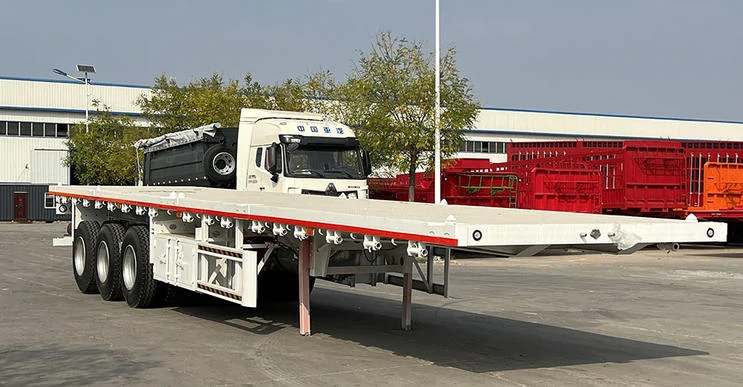
Understanding Flatbed Semi Trailer Height Standards
Flatbed semi trailer height typically refers to the distance from the ground to the top surface of the trailer deck when unloaded and parked on level ground. This dimension differs from overall vehicle height, which includes the cargo.
In most global markets, standard flatbed trailers are designed to balance payload capacity and legal height limits. In North America, the commonly accepted trailer deck height ranges between 1.45 and 1.55 meters, while variations exist in Europe, Australia, and parts of Asia due to axle and suspension regulations.
The deck height must allow sufficient clearance for axles and suspension travel while keeping the cargo center of gravity as low as possible. This balance is essential for stability at highway speeds and during cornering.
From a manufacturing perspective, experienced builders like a professional semi trailer manufacturer will adjust frame structure, cross-member spacing, and axle positioning to achieve height consistency across different load ratings.
How Trailer Height Affects Legal Compliance and Transport Efficiency
Trailer height has a direct relationship with maximum legal vehicle height, which is typically capped at around 4.0 to 4.3 meters in many regions. A higher deck reduces the available vertical space for cargo before exceeding legal limits.
For example, transporting steel structures, machinery, or prefabricated components often requires careful height calculations. A flatbed with a 1.55-meter deck may restrict cargo options compared to a lower-deck design, especially when overhead clearance is limited.
Lower deck heights also improve aerodynamic performance and reduce wind resistance, which can translate into fuel savings for long-haul operations. For fleet owners managing large volumes, even minor efficiency gains can significantly affect annual operating costs.
Height consistency is equally important in multimodal transport scenarios, where trailers may need to interface with loading docks, cranes, or rail systems.
Key Factors That Determine the Height of a Flatbed Semi Trailer
Axle Configuration and Tire Size
The number of axles and the tire diameter have a major influence on deck height. Larger tires increase ground clearance but raise the deck surface. Tri-axle configurations often require higher frames than tandem axles due to load distribution requirements.
Axle placement relative to the kingpin also affects weight balance and suspension compression, indirectly influencing static and dynamic height.
Suspension Type
Air suspension systems allow limited ride-height adjustment, making them popular for operations requiring flexibility. Mechanical suspension systems, while more robust in harsh environments, usually result in a fixed deck height.
Buyers operating in mixed conditions often prioritize air suspension for its adaptability, especially when loading uneven cargo.
Frame Design and Material Thickness
High-tensile steel frames allow thinner profiles without compromising strength. This enables manufacturers to reduce deck height while maintaining payload capacity.
Reinforced cross-members and optimized beam geometry also help lower the trailer profile, particularly in heavy-duty applications.
Intended Cargo Type
General freight, containers, machinery, and oversized loads all impose different requirements. Flatbeds designed for container transport often follow standardized heights, while project cargo trailers may be optimized for the lowest possible deck height to accommodate tall loads.
Typical Height Ranges for Flatbed Semi Trailers
The following table summarizes common flatbed semi trailer height ranges based on configuration and application.
Table 1: Typical Height Ranges of Flatbed Semi Trailers
| Trailer Configuration | Deck Height Range | Common Applications |
|---|---|---|
| Standard tandem axle flatbed | 1.45–1.50 m | Palletized freight, steel products |
| Tri-axle flatbed | 1.50–1.55 m | Heavy machinery, construction materials |
| Low-profile flatbed | 1.35–1.45 m | Tall or over-height cargo |
| Air suspension flatbed | Adjustable within range | Mixed cargo, long-haul logistics |
Choosing the Right Height for Different Transport Scenarios
Selecting the correct flatbed height is a strategic decision rather than a purely technical one. Buyers must consider route restrictions, cargo turnover frequency, and future operational needs.
For high-volume freight carriers, a standard-height flatbed offers versatility and compliance with most regulations. For specialized operators, a lower deck height may justify higher upfront costs due to expanded cargo options and reduced permit requirements.
Companies sourcing a flatbed semi trailer for sale should evaluate not only current cargo profiles but also long-term business growth plans.
Midway through the specification process, it is often valuable to consult directly with the manufacturer to model height scenarios against real cargo dimensions.
Contact our engineering team to discuss the optimal flatbed trailer height for your transport needs.
Operational Risks of Incorrect Trailer Height Selection
An improperly selected deck height can create hidden costs. Excessive height may lead to frequent over-height permits, route detours, or cargo limitations. Insufficient clearance can cause suspension bottoming, tire wear, or frame stress under load.
Height inconsistencies across a fleet can also complicate maintenance planning and driver training, especially when trailers are swapped frequently.
Professional buyers mitigate these risks by standardizing specifications and working with manufacturers capable of precise engineering control.
Flatbed Height Considerations in Global Transport Markets
Different regions impose unique constraints. In North America, bridge clearance and interstate regulations dominate height decisions. In Europe, axle load limits and overall vehicle length play a larger role. In Australia, road train compatibility and terrain resilience influence deck height choices.
Understanding these regional factors is critical when sourcing trailers for cross-border or export operations. Platforms like a configurable flatbed semi truck trailer allow buyers to adapt height specifications to different regulatory environments.
Frequently Asked Questions (FAQ)
What is the standard height of a flatbed semi trailer?
Most standard flatbed semi trailers have a deck height between 1.45 and 1.55 meters, depending on axle and suspension configuration.
Can flatbed trailer height be customized?
Yes. Manufacturers can adjust frame design, suspension, and tire size to achieve lower or higher deck heights within safety limits.
Does lower deck height increase payload capacity?
Not directly. Payload capacity depends on axle ratings and frame strength, but a lower deck can improve stability and cargo flexibility.
How does air suspension affect trailer height?
Air suspension allows limited ride-height adjustment, which can help during loading or when navigating uneven terrain.
Is trailer height regulated by law?
Trailer deck height itself is not always regulated, but it directly affects compliance with overall vehicle height limits imposed by transport authorities.
About Fuyuan
Fuyuan is a specialized semi trailer manufacturer dedicated to engineering reliable transport solutions for global logistics, construction, and industrial sectors. With a strong focus on structural integrity, compliance, and customization, Fuyuan designs flatbed semi trailers that balance optimal height, load capacity, and long-term durability. Our technical team works closely with clients to deliver trailers that perform consistently across demanding operating environments.
References
Wikipedia – Semi-trailer
https://en.wikipedia.org/wiki/Semi-trailer
Wikipedia – Flatbed trailer
https://en.wikipedia.org/wiki/Flatbed_truck
Federal Highway Administration (FHWA) – Vehicle Size and Weight
https://ops.fhwa.dot.gov/freight/policy/rpt_congress/truck_sw_laws/