


How Tall Is a Flatbed Semi Trailer and How Should Fleet Managers Plan Around It?
February 13, 2026
How tall is a flatbed semi trailer? In standard North American configurations, the deck height of a flatbed semi trailer typically measures between 48 and 60 inches from the ground. However, the more critical metric for transport planning is total loaded height, which in most U.S. states is limited to 13 feet 6 inches without special permits. For procurement leaders and logistics planners, understanding both deck height and maximum legal height is essential for avoiding route restrictions, minimizing permit costs, and protecting delivery timelines.
Height is not merely a physical dimension. It is a compliance variable, a route planning parameter, and in many cases, a cost control lever. Selecting the right trailer configuration can mean the difference between standard interstate operation and complex oversize logistics management.
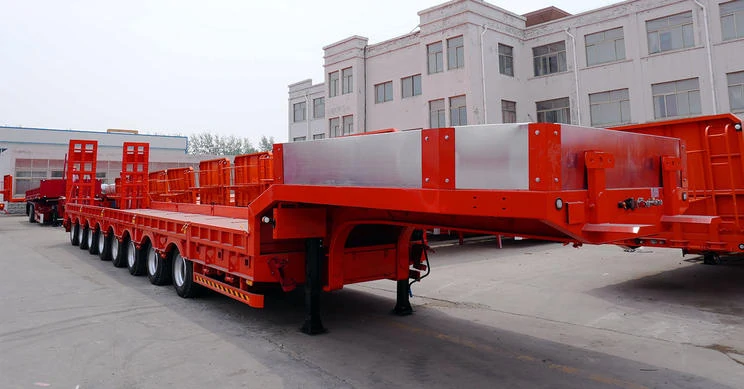
Deck Height vs Overall Vehicle Height: Clarifying the Difference
One of the most common misunderstandings in fleet procurement involves confusing deck height with total vehicle height.
Deck height refers to the vertical distance from the ground to the trailer’s loading surface. This determines how high cargo sits before any freight is added.
Overall vehicle height refers to the combined measurement of:
- Ground to deck
- Deck to top of cargo
Most states enforce a maximum overall height of 13 feet 6 inches for commercial vehicles operating without permits. This regulatory norm directly impacts cargo planning strategies.
For companies operating a flatbed semi trailer, even a difference of two inches in deck height can significantly influence which machinery, steel structures, or prefabricated components can be transported legally.
What Determines the Height of a Flatbed Trailer?
Deck height is not arbitrary. It is the outcome of engineering decisions across multiple systems.
Suspension Architecture
Air ride suspension systems are widely used for their ride stability and cargo protection benefits. While they provide minor flexibility in ride characteristics, they do not fundamentally alter regulatory height limits. Mechanical suspensions are structurally robust and cost effective but fixed in geometry.
Tire and Wheel Specifications
Standard 22.5 inch commercial tires contribute to the baseline elevation of the trailer frame. Larger tire diameters increase ground clearance but also increase deck height. Tire standardization across a fleet can simplify maintenance but may reduce dimensional flexibility.
Frame and Cross Member Design
The thickness of main beams, spacing of cross members, and structural reinforcements for heavy duty applications all contribute incrementally to overall deck height. Heavy load rating trailers often require stronger beams, which may slightly increase elevation.
When evaluating equipment from a semi trailer manufacturer, dimensional drawings and engineering schematics should be reviewed alongside load rating documentation.
How Height Affects Freight Strategy and Revenue
Height influences which cargo categories can be transported within standard legal limits. This has direct commercial implications.
Industrial Equipment Transport
For example, if a flatbed deck sits at 54 inches and the legal maximum overall height is 13 feet 6 inches, cargo can measure approximately 9 feet tall before permits are required. If the deck height is reduced to 48 inches, allowable cargo height increases by 6 inches. In heavy industry logistics, those inches can determine whether a shipment requires escorts, route surveys, or special permissions.
Construction and Modular Freight
Prefabricated construction components, steel trusses, and modular units often push height limits. Selecting a lower deck configuration may reduce permit frequency and improve scheduling predictability.
Permit and Administrative Costs
Oversize permits vary by state and may involve:
- Application processing fees
- Escort vehicle requirements
- Restricted travel hours
- Route approvals
Minimizing height exceedances lowers administrative overhead and reduces risk of delay.
If your operation involves tall cargo and complex route planning, our engineering team can help define the optimal trailer configuration: Discuss your height requirements with Fuyuan.
Comparing Flatbed Variants by Deck Height
While standard flatbeds dominate general freight markets, alternative configurations provide different dimensional advantages.
Table 1. Comparative Deck Heights by Trailer Configuration
| Trailer Configuration | Approximate Deck Height | Primary Advantage |
|---|---|---|
| Standard Flatbed | 48–60 inches | Versatility for general cargo |
| Step Deck (Drop Deck) | 36–42 inches (lower section) | Increased cargo height allowance |
| Double Drop Trailer | 18–24 inches (well area) | Extreme height accommodation |
| Heavy Duty Reinforced Flatbed | 50–60 inches | Higher structural load capacity |
Step deck and double drop designs sacrifice uniform deck elevation to provide lower cargo placement zones. These configurations are especially valuable for transporting taller equipment while remaining within 13 feet 6 inches.
Organizations reviewing a semi trailer for sale should align trailer type with their dominant cargo height profile rather than defaulting to standardized fleet purchases.
Infrastructure and Route Planning Considerations
Height planning extends beyond regulatory compliance into infrastructure compatibility.
Bridge and Overpass Clearance
Transportation authorities publish minimum bridge clearance data, but real world conditions vary. Infrastructure built decades ago may not fully align with modern freight dimensions.
Height miscalculations can lead to infrastructure strikes, which carry severe financial and legal consequences.
Warehouse and Dock Interface
Although flatbeds typically load from the side via crane or forklift, certain facilities require alignment with dock systems or loading ramps. Excessively high deck elevations can complicate forklift entry angles and loading efficiency.
International Operations
Height regulations vary internationally. European Union height standards, for example, commonly permit 4 meters (approximately 13 feet 1.5 inches) as a maximum vehicle height in many regions. Global fleet operators must adapt trailer selection to cross border requirements.
Height is therefore a planning dimension that intersects with geography, infrastructure age, and industry sector.
Engineering Customization and Procurement Strategy
Height optimization should be integrated into a broader equipment procurement framework.
Procurement teams should evaluate:
- Standard cargo height distribution
- Percentage of oversize shipments annually
- Geographic operating zones
- Long term fleet standardization objectives
- Resale value implications
Customizing deck height slightly lower can provide ongoing compliance flexibility. However, excessive customization may complicate fleet uniformity and maintenance planning.
The objective is balance. Structural integrity, load rating, suspension reliability, and dimensional compliance must be engineered together rather than optimized independently.
Frequently Asked Questions
What is the typical deck height of a flatbed semi trailer?
Most standard flatbed trailers measure between 48 and 60 inches from ground to deck.
What is the maximum legal height for loaded flatbed trailers in the United States?
In most states, the common legal maximum without special permits is 13 feet 6 inches.
Does lowering deck height reduce load capacity?
Not inherently. Proper structural engineering ensures that reduced deck elevation does not compromise rated load capacity.
When is a step deck preferable to a standard flatbed?
A step deck is beneficial when cargo frequently approaches legal height limits on a standard flatbed configuration.
Can height specifications be customized by the manufacturer?
Yes. Frame geometry, suspension components, and tire selection can be configured to meet specific operational requirements.
About Fuyuan
Fuyuan is a professional semi trailer manufacturer focused on delivering technically engineered transport equipment for construction, industrial logistics, and heavy haul sectors. Our production systems combine advanced fabrication technology, precision welding standards, and rigorous dimensional inspection protocols.
We design flatbed trailers with optimized deck height configurations to help fleet operators manage regulatory compliance, cargo versatility, and long term performance. From standard platforms to application specific builds, Fuyuan supports decision makers seeking reliable equipment aligned with measurable operational outcomes.
Reference
Federal Highway Administration. Vehicle Size and Weight Regulations.
https://ops.fhwa.dot.gov/freight/publications/brdg_frmwrk/sect2.htm
Wikipedia. Vehicle Size and Weight.
https://en.wikipedia.org/wiki/Vehicle_size_and_weight
Federal Motor Carrier Safety Administration. Regulations and Guidance.
https://www.fmcsa.dot.gov/regulations



